Beginner's Guide to Mobile Interval Timers and Run/Walk Apps: Building Running Endurance Safely
Discover the best mobile interval timers and progressive run/walk training apps designed to build cardiovascular endurance, prevent overuse injuries, and structure beginner running routines.
Starting a running journey is one of the most rewarding fitness goals you can set, yet more than half of novice runners quit within their first six weeks. The culprit is almost never a lack of willpower or motivation—it is poor pacing and structural fatigue. When beginners step out the front door and attempt to jog continuously for 20 or 30 minutes, they rapidly breach their lactate threshold, experience debilitating breathlessness, and subject unconditioned tendons, calf muscles, and knees to repetitive impact forces that invite shin splints and plantar fasciitis.
The most reliable, scientifically validated method to build lasting cardiovascular endurance without breaking down your body is the run/walk interval method. By alternating controlled jogging intervals with brief walking recovery periods, you keep your heart rate in an aerobic training zone (Zone 2), dramatically reduce muscle micro-tears, and accumulate substantial training volume with minimal orthopedic stress.
Modern smartphones make executing these structured workouts effortless. Instead of constantly checking your wrist or manually calculating elapsed minutes, mobile interval timers and dedicated run/walk coaching apps deliver seamless audio cues directly through your earbuds. In this guide, we evaluate the best mobile interval timers and progressive running apps, break down how to configure your smartphone for seamless tracking, and provide a battle-tested blueprint to help you transition safely from walking to sustained endurance running.
The Physiology of Run/Walk: Why Intervals Accelerate Endurance
The run/walk training philosophy—popularized by Olympian Jeff Galloway—relies on a simple physiological principle: preventing cumulative fatigue before it occurs.
When you run without stopping, your fast-twitch muscle fibers are recruited rapidly as slow-twitch postural muscles tire. This shift triggers lactic acid accumulation, elevates core body temperature, and degrades running biomechanics (leading to heavy heel striking and pelvic instability). By inserting a scheduled 30- to 60-second walking break before exhaustion sets in, several physiological adaptations happen:
- Cardiovascular Regulation: Your heart rate drops by 10 to 15 beats per minute during the walk interval, keeping you squarely within the aerobic zone where mitochondrial density and capillary beds develop most efficiently.
- Impact Load Dissipation: Walking reduces ground reaction forces from roughly 2.5–3 times your body weight down to approximately 1.2 times your body weight, giving connective tissues micro-recovery windows.
- Neuromuscular Reset: Brief walking intervals allow leg muscles to clear waste metabolites and maintain optimal cadence (steps per minute) during the subsequent running segment.
- Psychological Manageability: Breaking a 30-minute workout into discrete 90-second running segments eliminates mental dread and reinforces positive habit formation.
To harness these benefits, however, your mobile app must manage time precision, audio mixing, and background processing reliably.
Key Criteria for Choosing a Running Interval App
Not every timer app handles outdoor workouts well. Before picking a tool, ensure it meets the following standards:
- Audio Ducking and Voice Synthesis: The app must smoothly lower (“duck”) your music, audiobook, or podcast volume to deliver audible transition chimes or spoken cues, then seamlessly restore the volume without skipping.
- Background Persistence: The timer and GPS tracking must continue running reliably when your phone screen turns off, when you lock the device, or when switching between camera and music apps.
- Wearable and Lock-Screen Integration: Support for glanceable lock-screen widgets, dynamic island indicators, or companion smartwatch apps (Apple Watch and Wear OS) allows you to check remaining interval splits without breaking stride.
- Granular Customization vs. Pre-Structured Plans: Some runners need rigid, day-by-day coaching (like Couch to 5K), while others need an open interval builder to program custom splits (e.g., 2 minutes run / 1 minute walk).
Top Dedicated Mobile Interval Timers
If you prefer full control over your workout intervals or want to follow a personalized progression schedule, dedicated interval timers are far superior to generic stopwatch apps.
1. Seconds Pro Interval Timer (iOS & Android)
Seconds Pro remains the benchmark interval timer for athletes worldwide. Unlike basic gym countdown apps, Seconds Pro provides a visual and auditory environment purpose-built for outdoor endurance intervals.
- High-Contrast Color Coding: You can assign distinct colors to your running and walking intervals (e.g., high-visibility electric green for running, calm amber for walking). When mounted on an armband or bicycle mount, you can perceive the workout phase from peripheral vision alone.
- Text-to-Speech Interval Announcements: Instead of ambiguous beeps, Seconds Pro speaks your custom interval titles aloud (“Run at easy pace for two minutes,” “Walk recovery for sixty seconds”).
- Flawless Audio Ducking: The audio engine integrates cleanly with Spotify, Apple Music, YouTube Music, and Pocket Casts, temporarily lowering media playback by your preferred decibel offset before restoring it.
- One-Time Purchase Option: Unlike apps trapped behind recurring monthly subscriptions, Seconds Pro offers an accessible one-time upgrade to unlock unlimited saved routines.
2. Intervals Pro: Workout Timer (iOS & Apple Watch)
For runners embedded in the Apple ecosystem, Intervals Pro delivers deep integration with Apple HealthKit and the Apple Watch workout engine.
- Heart Rate Zone Threshold Alerts: You can tie interval targets to real-time heart rate zones captured via Apple Watch or a paired Bluetooth chest strap. If your heart rate spikes above Zone 3 during a warm-up or recovery walk, the app alerts you to ease your pace.
- Haptic Taptic Feedback: On the Apple Watch, distinct haptic pulses tap your wrist when it is time to switch phases, allowing you to run completely silent without earbuds if desired.
- Complex Nested Sets: The interval builder supports nested ladders (e.g., 1 min run / 1 min walk, building to 3 min run / 1 min walk, then tapering back down) for runners progressing beyond basic static splits.
3. Tabata Stopwatch Pro & Simple Interval Timer (Android & iOS)
For runners who want zero clutter, zero setup friction, and zero ad banners, lightweight timers like Simple Interval Timer or Tabata Stopwatch Pro strip away telemetry in favor of pure speed:
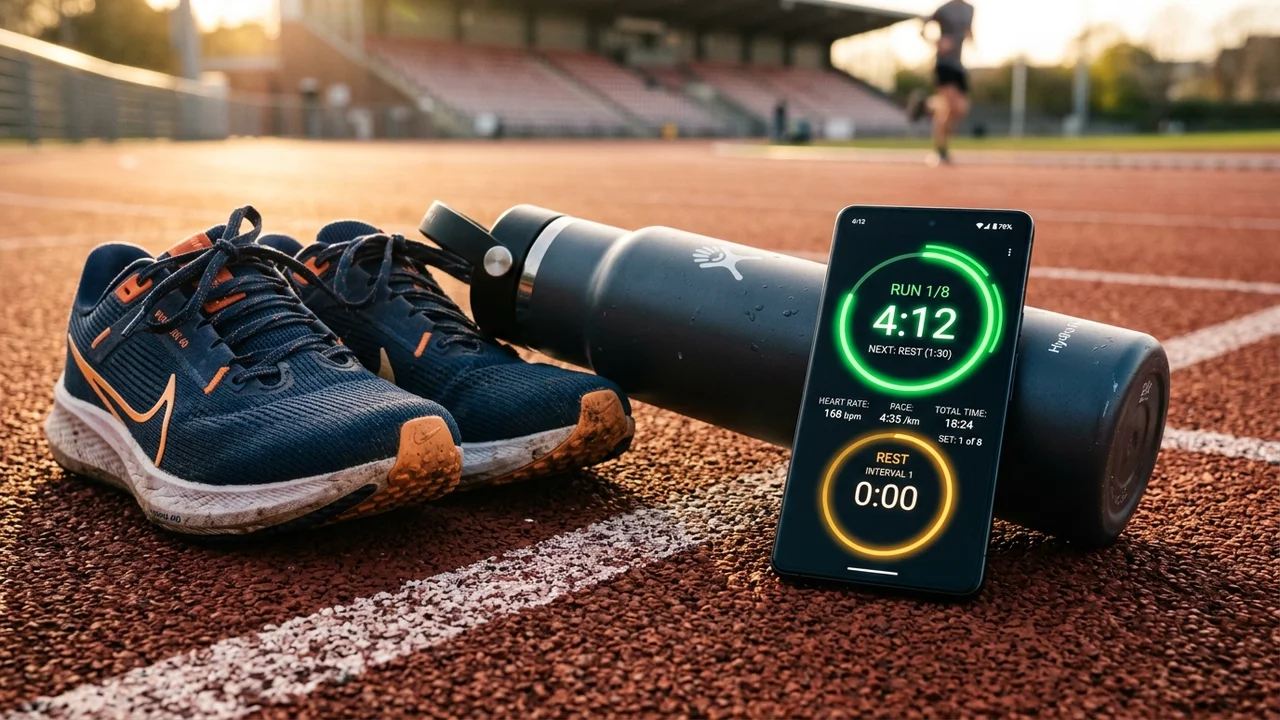
- Quick dual-dial setup: Set “Work” to 01:30, “Rest” to 01:00, and “Sets” to 10.
- Minimal battery draw: Because it does not poll continuous GPS satellites, battery consumption remains under 2% per hour.
- Ideal for track workouts or neighborhood loops where distance is already measured and only time prompts are required.
Top Progressive Run/Walk Training Apps
If you want an app that takes the guesswork out of progression by prescribing daily routines, these structured coaching apps provide expert progression curves.
Progressive Run/Walk Development Model:
┌─────────────────┐       ┌─────────────────┐       ┌─────────────────┐
│  Phase 1: Build │       │ Phase 2: Shift  │       │ Phase 3: Steady │
│ 60s Run / 90s Wk│ ───►  │ 3m Run / 1m Walk│ ───►  │ Continuous Jog │
│ Cardiovascular  │       │ Connective      │       │ Aerobic Engine  │
│ Conditioning    │       │ Tissue Load     │       │ Established     │
└─────────────────┘       └─────────────────┘       └─────────────────┘
1. None to Run (N2R) – The Smarter Alternative to Couch to 5K
While the famous “Couch to 5K” (C25K) program is an industry household name, it ramps up running duration too aggressively for many true beginners—often leaping from 90-second jogs to 5-minute continuous blocks in just three weeks.
None to Run was designed specifically to fix this steep difficulty curve:
- Gentle 12-Week Progression: Week 1 starts with just 30 seconds of slow jogging followed by 2 minutes of walking, repeated across a manageable 25-minute workout.
- Integrated Mobility and Strength Routines: Running endurance requires stabilizer strength. N2R embeds simple, 5-minute bodyweight routines (glute bridges, calf raises, side planks) directly within the weekly schedule to protect ankles, hips, and knees.
- Effort-Based Rather Than Pace-Obsessed: The app encourages conversational, easy effort rather than demanding strict speed metrics, instilling sustainable habits.
2. Just Run (Android & iOS) – The Clean, No-Nonsense C25K
If you want the classic Couch to 5K progression but despise intrusive pop-up ads, subscription walls, and mandatory account registrations, Just Run is a triumph of clean mobile development:
- 100% Free and Open Ethos: No data harvesting, no paywalls, and no pop-ups interrupting your warmup.
- Minimalist Aesthetic: Features a crisp Material Design interface with bold timers, clean audio prompts, and notification bar controls.
- C25K and 5K-to-10K Programs: Includes both the traditional beginner 9-week 5K schedule and an intermediate 6-week bridge program to reach 10 kilometers.
3. Runna: Personalized Coaching & Dynamic Progression
For beginners who want an elite, tailored running coach on their phone and are willing to invest in a premium subscription, Runna offers exceptional adaptive technology:
- Personalized Pace Targets: Based on a quick conversational fitness assessment, Runna calculates your exact conversational running pace and walk intervals.
- Dynamic Adjustments: If you complete a workout and rate it as “too hard” or “too easy,” future sessions automatically recalibrate interval durations.
- Garmin, COROS, and Apple Watch Sync: Workouts sync natively to dedicated GPS sports watches as structured workouts, vibrating your watch automatically at every segment boundary.
App Comparison Matrix
| Application | Primary Focus | Best Suited For | Audio Ducking | Wearable Companion | Pricing Model |
|---|---|---|---|---|---|
| Seconds Pro | Custom Interval Engine | Self-directed runners wanting bespoke splits | Yes (Flawless) | Apple Watch, Wear OS | Free trial / One-time upgrade |
| Intervals Pro | Heart Rate & HealthKit | Apple Watch runners monitoring zones | Yes | Apple Watch (Standalone) | Free tier / One-time purchase |
| None to Run | Gentle 12-Week Couch Plan | True beginners prone to shin splints or fatigue | Yes | Apple Watch | Monthly / Annual subscription |
| Just Run | Classic C25K Structure | Budget-conscious runners wanting zero ads | Yes | Basic lock screen controls | 100% Free / Optional donation |
| Runna | Adaptive Training & Plans | Runners aiming for eventual 5K/10K race goals | Yes | Apple Watch, Garmin, COROS | Premium subscription (7-day trial) |
Technical Setup Guide: Preventing Battery Killers and Missed Cues
Nothing ruins a workout faster than having your interval timer freeze in the middle of a run because your phone’s operating system silently terminated the app to conserve battery. Follow this optimization checklist before your first session:
For Android Users (Samsung, Google Pixel, Xiaomi, OnePlus)
- Disable Battery Optimization for Your Timer:
- Go to Settings > Apps > [Your Timer App] > Battery.
- Change the setting from Optimized to Unrestricted.
- Prevent Background App Freezing (Samsung One UI):
- Go to Settings > Battery > Background usage limits.
- Ensure your interval app is added to Never sleeping apps.
- Grant Background Location Permissions:
- If using GPS tracking alongside intervals, set Location permissions to “Allow all the time” rather than “Only while using the app.”
For iPhone Users (iOS)
- Enable Background App Refresh:
- Navigate to Settings > General > Background App Refresh and ensure it is toggled On for your chosen running app.
- Configure Fitness Focus / Do Not Disturb Exceptions:
- Create a dedicated Fitness Focus mode that silences incoming social media pings and work messages while allowing audio cues from your interval timer and music player to pass through uninterrupted.
- Volume Normalization:
- In your music app (e.g., Spotify: Settings > Playback > Enable Audio Normalization), balance audio levels so voice prompts are not overpowered by high-decibel music tracks.
4-Week Progressive Run/Walk Blueprint for Absolute Beginners
If you are starting from scratch or returning to physical activity after months away, use this 4-week progression schedule with any interval timer. Complete three workouts per week on non-consecutive days (e.g., Tuesday, Thursday, Saturday).
Target Cadence: 165 - 175 steps per minute (short, light strides)
Effort Scale: RPE 4-5 out of 10 (You should be able to speak full sentences)| Week | Warm-Up Walk | Interval Structure (Run / Walk) | Repetitions | Total Workout Time | Progression Focus |
|---|---|---|---|---|---|
| Week 1 | 5 mins brisk walk | 60 sec Jog / 90 sec Walk | 8 sets | 25 minutes | Finding an easy conversational pace; avoid sprinting |
| Week 2 | 5 mins brisk walk | 90 sec Jog / 90 sec Walk | 7 sets | 26 minutes | Maintaining light, quick footfalls under your center of gravity |
| Week 3 | 5 mins brisk walk | 2 min Jog / 1 min Walk | 7 sets | 26 minutes | Managing breathing rhythm (in for 3 steps, out for 3 steps) |
| Week 4 | 5 mins brisk walk | 3 min Jog / 1 min Walk | 6 sets | 29 minutes | Building aerobic efficiency; walking with energetic posture |
Actionable Takeaways for Long-Term Success
- Keep Your Easy Runs Truly Easy: During the running segments, you should be moving slow enough to hold a conversation without gasping. If you cannot speak a full sentence, reduce your jogging pace immediately. Speed comes after endurance, not before.
- Walk with Purpose: Walking intervals are active recovery segments, not full stops. Keep your head upright, shoulders relaxed, and swing your arms naturally to keep blood circulating.
- Invest in Proper Footwear First: No app can compensate for worn-out sneakers. Visit a local running specialty store for a gait analysis before increasing your weekly mileage.
- Trust the Consistency Curve: It takes six to eight weeks for tendons and ligaments to remodel and adapt to running stress. Celebrate finishing your scheduled interval blocks rather than chasing rapid distance or pace records.
With the right mobile interval timer quietly coaching you in your ear, you eliminate self-doubt, protect your joints, and build a lifelong foundation of cardiovascular fitness.